Nuts About Pecans!
Nuts About Pecans!
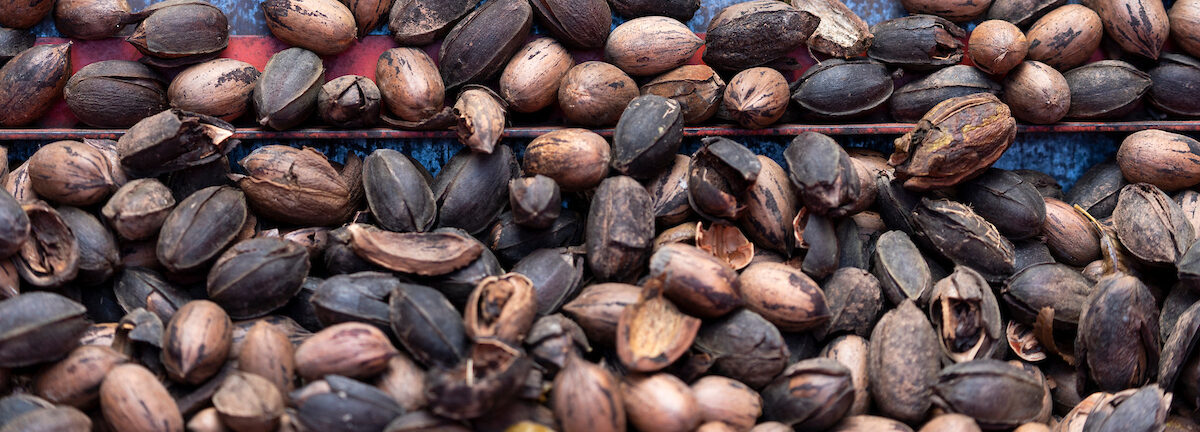
Carya illinoinensis, also known as pecans, are a highly valued nut crop, not only for their distinct flavor, but for the myriads of health benefits that they offer. Pecans are rich in nutrients and are recommended by the American Heart Association as they support heart health.
Pecan trees are native to North America with a broad environmental spectrum ranging from Illinois, USA to Oaxaca, Mexico. The pecan tree was officially adopted as the state tree of Texas in 1919, highlighting the tree’s significance in Texas history and culture. Native to the region and an important resource for both Native Americans and settlers alike, the pecan tree’s long-standing presence in Texas, along with its economic and ecological value, solidified its status as a state symbol.
El Paso County is one of the leading pecan-producing counties in Texas with over 17,000 acres of pecan orchards. The desert Southwest climate, which includes El Paso, is ideal for pecan cultivation. The dry climate reduces disease and fungal pressures that are common in the more humid regions of Texas. However, there are significant issues that need to be addressed, such as water availability and quality. What can growers do to help their trees succeed under these conditions? Our research will be tailored to address the specific needs that growers face in El Paso and the overall west region of Texas.
Ongoing Projects
Forecasting the Future: A Dynamic Model for Pecan Production
This project is developing a data-driven forecasting model for pecan production. By utilizing reliable, real-world data sources rather than estimates, the model will help growers make informed management and marketing decisions each crop year, improving planning and reducing uncertainty.
Elucidating the Fate and Impact of Nanoplastics and PFAS in Major Perennial Horticultural Crops in Texas and Their Sustainable Mitigation
Researchers are evaluating the presence and potential effects of nanoplastics and per- and polyfluoroalkyl substances (PFAS) in perennial horticultural crop systems across Texas. If impacts are identified, the project will investigate sustainable mitigation strategies to protect crop productivity, environmental quality, and consumer safety.
Developing and Deploying a Technology Suite to Effectively Measure, Mitigate, and Destroy Forever Chemicals (PFAS)
This community-focused project aims to address PFAS contamination in water resources. The research team is developing and deploying technologies to accurately detect, reduce, and eliminate PFAS—commonly known as “forever chemicals”—to support healthier communities and improved environmental stewardship.
Regenerative Agriculture: Management Practices
This project will examine the sustainability of various orchard floor management practices in Far West Texas. Researchers will evaluate their impact on water-use efficiency, soil health, tree health, labor requirements, production outcomes, and overall economic viability to identify best practices for regenerative orchard management.
Drought Tolerance Study in Pecan Seedlings
Previous research in other plant systems suggests that gradual and continuous exposure to drought conditions may enhance drought tolerance over time. This study seeks to determine whether similar adaptive responses can be induced in pecan seedlings, potentially leading to improved resilience under water-limited conditions.
Publications

Cervantes, K., Heerema, R.J., Randall, J., 2025. Fungal community observations of fully-watered and deficit-watered micropropagated rootstock pecan trees. Acta Hortic. 1420, 187-194. DOI: 10.17660/ActaHortic.2025.1420.25. https://doi.org/10.17660/ActaHortic.2025.1420.25
Cervantes, K. Velasco-Cruz, C., Grauke, L.J., Wang, X., Conner, P., Wells, L., Bock, C.H., Pisani, C., Randall, J.J., 2023. Influence of Geographical Orchard Location on the Microbiome from the Progeny of a Pecan Controlled Cross. Plants. 12(2):360.doi: 10.3390/plants12020360.


Cervantes, K., Heerema, R.J., Randall, J.J., 2022. The core microbiome of Carya illinoinensis (pecan) seedlings of different maternal pecan cultivars from the same orchard, Frontiers in Microbiomes, https://doi.org/10.3389/frmbi.2022.1003112.
Cervantes, K., Hilton, A.E., Stamler, R.A., Heerema, R.J., Bock, C., Wang, X., Jo, Y.K., Grauke, L.J., Randall, J.J. 2022. “Evidence for Seed Transmission of Xylella fastidiosa in Pecan (Carya illinoinensis)”. Frontiers. https://doi.org/10.3389/fpls.2022.780335


Ishimori, M., Takanashi, H., Fukami, K., Cervantes, K., Nagano, A.J., Kajiya-Kanegae, H., Grauke, L.J., Tsutsumi, N., Randall, J.J., Iwata, H., 2021. “Genome-wide RAD-Seq analysis revealed subpopulation structures of the pecan (Carya illinoinensis) germplasm collection and their relationship to geographical distribution patterns”. Acta Horticulturae. 10.17660/ActaHortic.2021.1318.26
Randall, J.J., Cervantes, K., Ray, D.K., Sanchez, A., Mason, K., Fisk, J.N., Soneji, J.R., Sanchez, L., Grauke, L.J., Wang, X., 2021. “Insights into the impact of geography and genetics on the microbiome of Carya illinoinensis”. Acta Horticulturae. 10.17660/ActaHortic.2021.1318.34.


Lovell, J.T., Bentley, N.B., Bhattarai, G., Jenkins, J.W., Sreedasyam, A., Alarcon, Y., Bock, C., Boston, L., Carlson, J., Cervantes, K., Clermont, K., Krom, N., Kubenka, K., Mamidi, S., Mattison, C., Monteros, M.J., Pisani, C., Plott, C., Rajasekar, S., Shadgou Rhein, H., Rohla, C., Song, M., St. Hilaire, R., Shu, S., Wells, L., Webber, J., Heerema, R.J., Klein, P.E., Wang, X., Grauke, LJ., Grimwood, J., Schmutz, J., and Randall, J.J. 2021. “Four chromosome scale genomes and a pan-genome annotation to accelerate pecan tree breeding.”, Nature Communications, 12, 4125 (2021). https://doi.org/10.1038/s41467-021-24328w.
Hilton, A., Wang, X., Zhang, M., Cervantes, K., French, J., Randall, J.J., Bock, C., Grauke, LJ., Jo, Y.K. 2020. “Improved methods for detecting Xylella fastidiosa in pecan and related Carya species.” European Plant Pathology,. 157:899–918 (https://doi.org/10.1007/s10658020-02050-5).


Hilton, A., Jo, Y.K, Cervantes, K., Stamler, R.A., French, J.M., Heerema, R.J., Goldberg, N.P., Sherman, J., Wang, X., Randall, J.J., Grauke, L.J., 2017. “First report of Xylella fastidiosa in Carya illinoinensis in Arizona, New Mexico, California, and Texas”. Plant Disease (doi.org/10.1094/PDIS-02-17-0298-PDN).
Faculty